
Feng just did the garbage.
Not just any garbage, but what we refer to as “the big garbage”.
And yes, I’m aware that this sentence isn’t proper English. But how else would you describe the tedious task of gathering five, six, seven, even ten plastic bags from the bathrooms, kitchen, basement and bedrooms (no, we don’t live in a mansion), tying them up and stuffing them into no more than two big black garbage bags, then hauling a blue bin or two full of cookie packages and Coke cans to the curb, nodding to the neighbours who are also “doing the garbage” at 10 p.m., and collectively praying that the raccoons or skunks won’t make a mess by morning?
“Are we going to use these jars?”
“No, we’re not,” I reply, opening a kitchen cupboard full of empty, washed glass jars—we all eat jam at some point during the day around here. “Are you planning to ever do anything with the two black bananas in the fridge?”
It’ll be easier and quicker next week, although not nearly as satisfying. Next week is black bin week, i.e. paper. Nobody has piles of newspapers anymore; it’s mostly junk mail, pizza and cracker boxes, and a few egg cartons.
Garbage isn’t a glamorous topic, but it’s fascinating.
Our garbage bins and bags tell the story of the seasons.
In winter, you don’t even know where to put them as the curb disappears, week after week, under giant snowbanks. There are two schools of thought: on top of the snowbank or on the hopefully cleared driveway. Just make sure they don’t get in the way of the snowplow; half the city bins seem to get accidentally cracked every winter.
In spring, tall brown bags are full of attempts to revive gardens, and in fall, they’re full of leaves. The City of Ottawa collects them on big garbage day—I like to imagine a team of civil servants in charge of preserving every last leaf and gluing them all back onto the trees once the snow melts, because it always seems mildly suspicious that nature somehow wakes up again after months of temperatures far too cold for anything to be alive.
Garbage bags tell an economic story too.
I’ve been here long enough to remember a few eras. Like around 2010, when everybody was buying flat-screen TVs, or more recently during the pandemic, when the garbage was mostly Styrofoam takeout containers and board game boxes bought to kill boredom.
Over the past few years, a new dance has started after midnight. Late at night, pickup trucks lined with old mattresses for padding slowly drive around the neighbourhood, salvaging metal and broken appliances. Then, even later, you hear the clatter of a few guys on bikes rummaging through every blue bin, looking for wine bottles or aluminium cans for deposit refunds or scrap value.
“That’s how I pay for my booze!” a guy once explained to me. “I can make like $30 a night!”
I almost felt bad that we don’t drink anything but Coke Zero after that.
But mostly, in suburbia, garbage tells stories, plural—about people you barely know.
I’ve always found it funny that Canadians, who live behind closed doors and windows, put everything on display every other week. It’s the opposite of France, where you often know way too much about your neighbours in apartment buildings, but garbage bags are dumped anonymously in the many public bins outside.
Unless you’re my mum’s former upstairs neighbour, who would always take his bottles down to the recycling bin when he was drunk—guilt, maybe. One step, one bottle rolling down the stairs, two steps, three bottles rolling down… preferably in the middle of the night, of course.
But in Ottawa suburbia, you can tell who had a baby from the diaper boxes, even though you may never actually see or hear the baby because pushing a stroller around isn’t really a thing in Canada. You can tell who relies on takeout, even though you’ll never see more than a door ajar and a hand reaching out to grab whatever some random Uber driver just brought for dinner. You can tell who redid a room from the rolled-up carpet at the curb, even though you’ll never set foot inside. You can guess who moved out because, once again, there’s a couch sitting at the curb.
Oh my God. Don’t get me started on couches, mattresses, dressers and everything else. It’s like every Canadian house is a magic box containing an infinite supply of furniture, which is surprising in a country where, granted, there are trees, but relatively few furniture stores and even fewer family antiques passed down through generations.
But it makes my Sunday walks interesting, at least. For a few hours every other week, the neighbourhood turns into a remarkably accurate collective autobiography.
Sometimes it’s more than autobiography. Sometimes it’s archaeology.
“Wait. This is…”
Earlier today, one of my neighbours stopped dead in her tracks during our walk.
“Chimney, no, wall, no… A BIRD BATH! THAT WAS A BIRD BATH!” she shouted, after apparently reassembling in her head a dozen broken pieces piled up at the curb one street over.
“I didn’t even know that was a thing,” I admitted.
“I guess not anymore,” she replied.


I first got up close and personal with other people’s garbage while living in Montreal. On the street where I lived, garbage collection was on Thursdays. On Wednesday, we all deposited our discards onto the sidewalks. In the evening, many of us walked up one side of the street and down the other looking for ‘treasures’. Many unusual items were collected and hauled home to decorate my two bedroom apartment. It was the eighties–rent $60/mo. Ah, those were the days. One such thing was a large magnetised advertisement for somebody’s business that had, apparently, fallen off a vehicle door at some point. Another was a ladder that I used to mount the platform in the living room which my brother built for me. It was a suspended bed from which I could see the entrance glass door at the end of a corridor. In the five years I lived there, my space was broken into four times. I slept with a hammer under the pillow. It was an era where, preceding an election/referendum, the voting lists of the people who inhabited the apartments were stapled to power poles. I was an easy target–single woman living alone. On one occasion one of the cops said that there was every indication it had been someone I knew and suggested that I get a new boyfriend. He provided his phone number. Only in Montreal!
This sounds… both fascinating and terrifying! It’s not *that* long ago too, for everything, from rent price the “helpful” suggestion. I hope nothing bad happened to you. I hope you never had to use this hammer either.
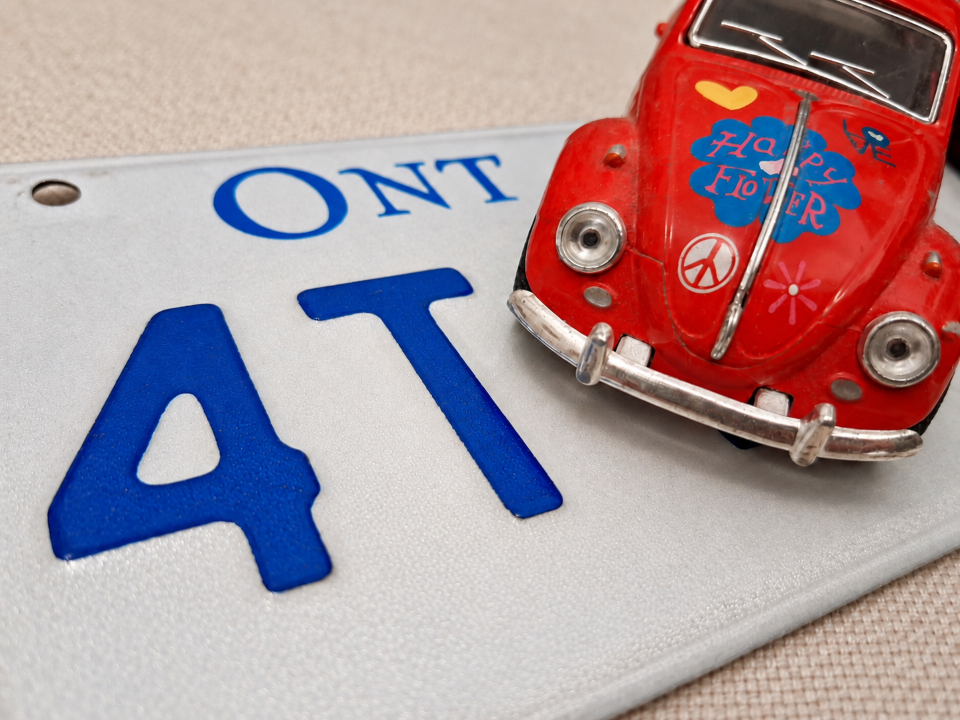
I have a few Ottawa-garbage-day items in my room as well, including a motorbike licence plate. No idea what’s the story behind it, it was on the ground on garbage day a few years ago so I took it.
The ladder/plateform setup sounds cool!